From compliance to management: why an EHSQ system should be part of the operation
Extract / Introduction
Occupational health and safety can no longer be managed in isolation from the rest of the organization. In complex operations, risks, the health of people, environmental performance, and process quality are all interconnected. Therefore, moving towards an integrated EHSQ system allows us to shift from a management approach based on documents and reactions to one that is continuous, measurable, and focused on prevention.
Management begins before the incident
An effective management system doesn't begin when an accident, nonconformity, or audit finding occurs. It begins much earlier: when the organization identifies its hazards, assesses its risks, defines responsibilities, establishes controls, and verifies whether those controls are actually working.
This approach aligns with the vision of the International Labour Organization (ILO), which views occupational safety and health management as a systemic process integrated into the planning and development of the company. The ILO-OSH 2001 guidelines highlight elements such as policy, organization, planning and implementation, evaluation, and continuous improvement actions.
For a company, this has an important consequence: safety doesn't just mean meeting a list of requirements. It means incorporating prevention into the daily way of operating.
Why talk about EHSQ and not just OHS?
In many organizations, Safety, Occupational Health, Environment, and Quality evolved as independent areas. Each developed its own formats, indicators, audits, responsible parties, and records. The result can be a large amount of information, but not necessarily a shared understanding of what is happening.
The EHSQ approach seeks precisely to overcome this fragmentation. An inspection finding may relate to a safety risk, an occupational health condition, an environmental requirement, or a quality deviation. A corrective action can simultaneously resolve several problems.
Integration doesn't mean eliminating specialties. It means connecting them so that management can observe the organization's performance as a system.
The five components of effective management
A robust EHSQ system needs, at a minimum, a structure that allows for defining objectives, executing controls, verifying results, and correcting deviations.
First and foremost is policy and management commitment. Without leadership, procedures end up becoming documents that few consult.
Next comes organization: clear responsibilities, skills, worker participation, and sufficient resources.
Planning transforms commitments into concrete actions. This includes hazard identification, risk assessment, environmental aspects, legal requirements, objectives, programs, and operational controls.
Evaluation allows us to know if what was planned is being carried out. Inspections, audits, indicators, investigations, measurements, and reviews provide the necessary evidence.
Finally, continuous improvement transforms that evidence into decisions: correct, prevent, modify controls, and re-evaluate.
The value of the system lies in the complete cycle, not in each element separately.
Information is part of operational control
When EHSQ information is scattered across spreadsheets, emails, folders, and local documents, the organization loses a significant part of its responsiveness.
This isn't just an administrative problem. If a finding lacks an assigned person, a due date, and follow-up, there's a real possibility it will remain unresolved. If an inspection doesn't reach the person who needs to act, the record becomes worthless. If an indicator is generated weeks after the event, it may be too late to intervene.
Digitization allows us to transform operational information into traceability. The goal is not to accumulate data, but to ensure that each piece of data has a purpose: to detect, decide, act, and verify.
- EHSQ Mantis: bringing the system into operation
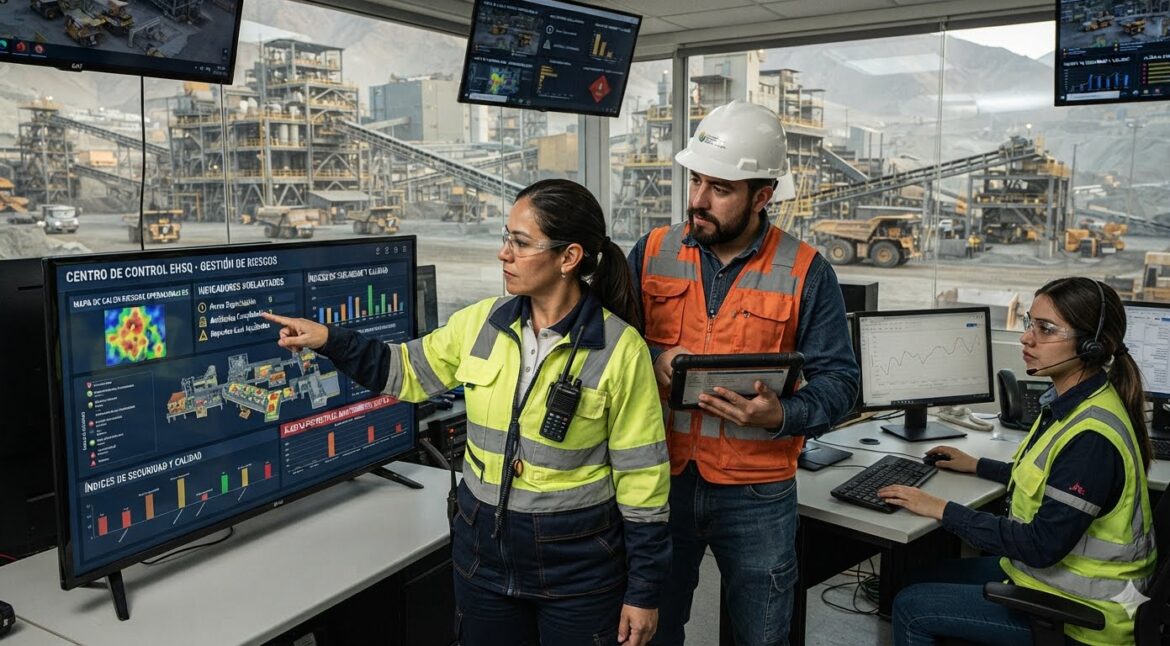
EHSQ Mantis Software is designed precisely under this logic of integration. The platform brings together Industrial Safety, Occupational Health, Environment, and Quality in a modular solution adaptable to the processes of each organization.
In Safety, it allows for the management of inspections, risks, work permits, findings, training, and corrective actions, among other processes. The Health module centralizes information related to medical surveillance and occupational monitoring. Environment incorporates waste traceability, compliance, and environmental performance. Quality facilitates document control, audits, nonconformities, and improvement actions.
The advantage of an integrated platform emerges when these processes cease to operate in isolation. Information can then follow a single cycle: identify, record, assign, act, verify, and measure.
Furthermore, the offline mobile application allows management to be transferred to the place where the activities actually take place: the field.
Conclusion: a system should not live in a folder
An EHSQ management system is valuable when it influences the organization's decisions and daily operations. Policies, procedures, and matrices are necessary, but not sufficient.
True maturity emerges when information arrives on time, those responsible know their tasks, findings are finalized, indicators are used to make decisions, and management can verify the evolution of performance.
Digital transformation does not replace individual responsibility or professional judgment. What it does is provide a framework so that knowledge can be translated into traceable and measurable actions.
EHSQ Mantis Software seeks precisely that objective: to transform the management of Safety, Health, Environment and Quality into a connected, auditable system oriented towards continuous improvement.