From data to risk: how to turn EHSQ information into preventive decisions
A company can have thousands of records of inspections, incidents, training sessions, audits, and medical checkups, and still lack useful information for prevention. The problem is usually not a lack of data, but rather the difficulty in relating, interpreting, and translating it into actionable decisions. Modern EHSQ management needs to take that step: moving from simply recording events to understanding the risks involved.
Registering is not managing
For years, many safety and health areas have measured their performance by the number of activities carried out: inspections performed, training sessions given, forms completed, or audits conducted.
This data is necessary, but it doesn't always explain whether the organization is improving. Mature management needs to ask what happened after each activity. What were the recurring findings? Which areas show the most deviations? Which actions remain open? What risks appear repeatedly? Which controls are failing?
The difference between recording and managing lies precisely there: in using information to modify reality.
Prevention needs context
A single indicator can be misleading. Ten findings in one plant do not mean the same as ten findings in ten different plants. An incident rate can mask problems if exposure has changed. A decrease in reports can be positive, but it can also reflect a loss of worker participation.
Therefore, the EHSQ system must relate the data to processes, areas, equipment, contractors, types of risk, responsible parties, dates and actions taken.
Traceability allows us to reconstruct the history of a deviation: where it appeared, who detected it, what action was taken, how long it took to resolve, and whether it happened again. This sequence is far more valuable than a single number.
Indicators that help in deciding
An EHSQ dashboard should not become a collection of charts. Each indicator should answer a management question.
For example: What critical risks have expired controls? How many corrective actions are overdue? In which areas are the same findings repeated? Which contractors have the highest number of deviations? Which legal requirements present the greatest exposure? What training is critical and pending?
It is also important to combine preventive and reactive indicators. Accidents and incidents show what has already happened. Inspections, observations, controls, open actions, and exposure trends can show signs prior to the event.
The goal is not to predict the future with certainty. It is to improve the organization's ability to recognize signs and act promptly.
Artificial intelligence takes things to the next level.
Artificial intelligence can bring new capabilities to the EHSQ system when used with organized and reliable information. It can help classify records, find patterns, summarize information, identify recurrences, and support the analysis of large volumes of data.
However, AI does not replace professionals in Safety, Health, Environment, or Quality. An automated recommendation must be interpreted within the operational context and validated by those familiar with the activity.
The real value emerges when technology reduces the time spent searching for and organizing information, allowing more time to be spent analyzing risks and making decisions.
EHSQ Mantis: a platform for connecting information
EHSQ Mantis Software It integrates Industrial Safety, Occupational Health, Environment, and Quality processes onto a single platform. This architecture allows information generated in the field and in administrative processes to be transformed into traceability, monitoring, and indicators.
Inspections, findings, audits, training, corrective actions, health controls, environmental compliance, and quality processes can all be managed within a common environment.
The mobile app facilitates data capture in the field, even without a continuous internet connection, while the central platform allows for the consolidation and retrieval of information. This way, the data is not isolated on a single device or spreadsheet.
The incorporation of AI-powered capabilities also opens up the possibility of evolving from simply querying information to supporting tools for analysis and prioritization.
A new culture: deciding with evidence
EHSQ's digital transformation isn't about replacing paper with screens. Real change happens when the organization starts using available evidence to make better decisions.
An inspection should lead to action when a deviation exists. An action should be followed up on. A closure should be verifiable. A trend should generate a question. And a question should lead to a decision.
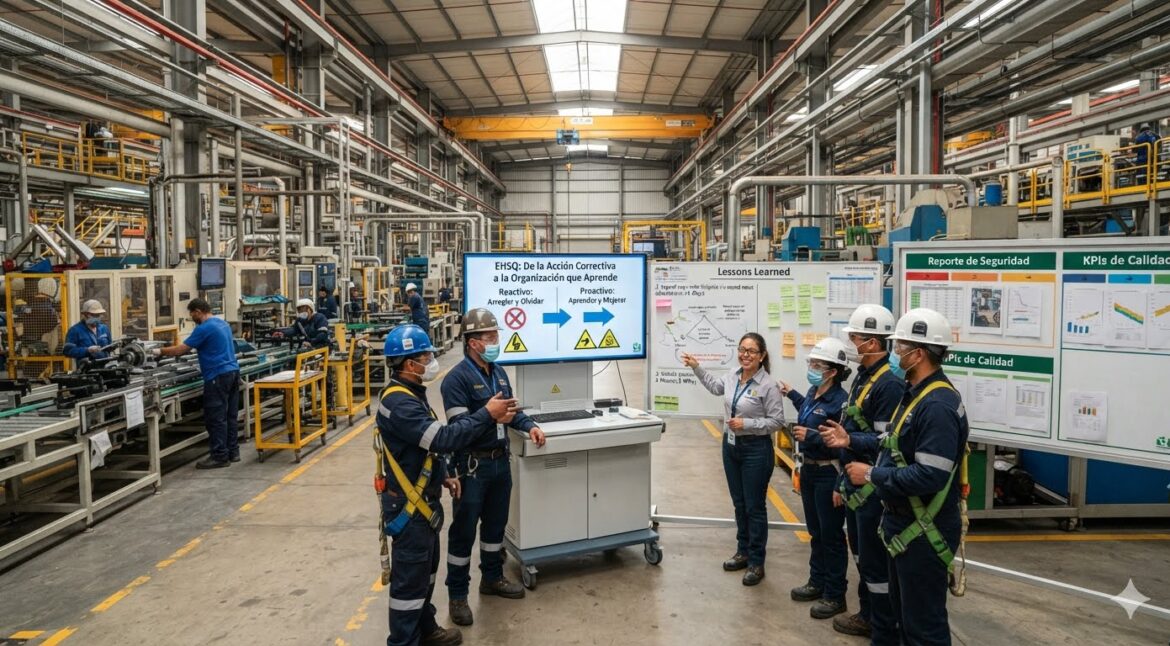
That circuit —data, analysis, action and verification— is one of the foundations of mature preventive management.
Therefore, technology only makes sense when it's integrated into the management system, not when it functions as a standalone tool. EHSQ Mantis aims precisely to connect these points so that Safety, Health, Environment, and Quality can be managed with a shared vision and with readily available information for decision-makers.