From data to decision
How artificial intelligence can strengthen EHSQ management without replacing professional judgment.
Modern organizations produce enormous amounts of information: inspections, incidents, observations, audits, training, evaluations, occupational health records, environmental indicators, non-conformities, and corrective actions.
The challenge is no longer just about collecting data. It's about quickly identifying what deserves attention. This is where artificial intelligence comes in as a new layer of analysis.
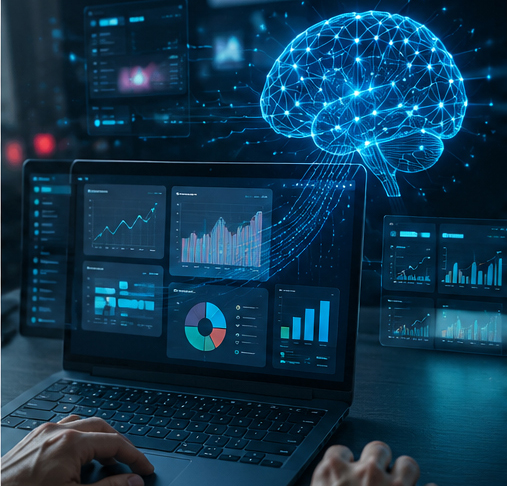
AI can process large volumes of information and help identify patterns that would be difficult to detect manually. However, in EHSQ, it should be understood as a management support tool and not as an autonomous authority on risk.
When data is isolated, it loses value
A company may have thousands of records and yet take hours to discover a trend because the information is spread across different systems.
An integrated platform allows for linking inspection, area, team, finding, risk, responsible party, action, date, evidence, and closure. This structure generates organizational memory: it not only preserves what happened, but also allows for consulting and learning from the accumulated information.
AI can help find what deserves attention
When applied correctly, it can help answer questions such as: what findings are repeated?, what actions have been open the longest?, what areas concentrate deviations?, what categories show recurrences?, what historical information is related to an event?
The final decision still rests with the professional. NIST proposes a risk management approach for AI that considers governance, identification, measurement, and management. In EHSQ, this means combining technological capabilities with controls, data quality, and human review.
EHSQ Mantis: Turning Information into Operational Knowledge
Mantis integrates modules for Safety, Health, Environment, and Quality. Safety covers processes such as inspections, risks, permits, audits, incidents, PPE, training, and corrective actions. Health centralizes occupational health and safety processes. Environment manages permits, waste, indicators, compliance, and traceability. Quality addresses documentation, audits, nonconformities, CAPA (Continuous Assessment and Protection), risks, changes, and indicators.
The platform offers dynamic dashboards, reports, and process centralization. On such an organized foundation, AI capabilities can be used to query, analyze, and better leverage accumulated knowledge.
From automation to intelligent prevention
Automating a task saves time. Analyzing information to decide where to intervene can generate greater change.
Evolution can be expressed as: record → organize → visualize → analyze → anticipate → act → learn.
AI doesn't replace a proactive culture or leadership. It can help information reach the right people faster, with enough context to act. The ultimate goal isn't more technology, but better decisions.