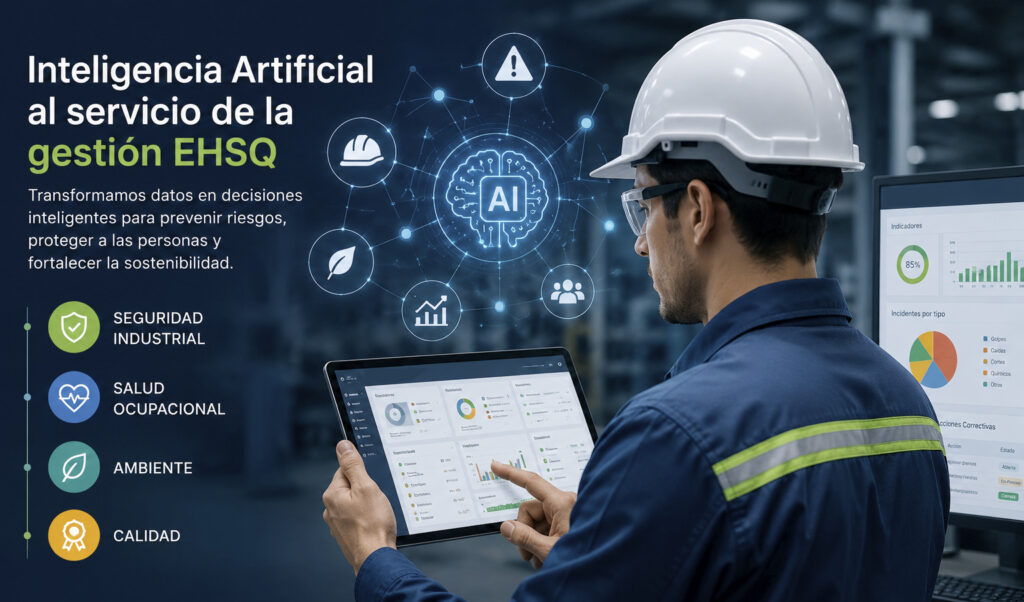
The evolution of artificial intelligence is bringing about a profound change in EHSQ management. Today, organizations can analyze large volumes of information in real time to identify risks, anticipate incidents, and strengthen decision-making in industrial safety, occupational health, environment, and quality.
Digital transformation in the industrial sector is entering a new phase. Artificial intelligence is no longer limited to analyzing data or generating reports; it is now evolving into autonomous systems capable of interpreting contexts, anticipating risks, and supporting real-time decision-making. This shift is profoundly redefining how organizations manage industrial safety, occupational health, the environment, and quality under the EHSQ approach.
For years, companies have made progress in digitizing their EHSQ processes. Systems have been implemented to record incidents, manage audits, handle work permits, and monitor performance indicators. However, much of this information has remained fragmented or used reactively.
The arrival of more advanced artificial intelligence models allows for a qualitative leap: moving from systems that only record information to platforms that learn from data, identify hidden patterns, and generate predictive alerts. This opens the door to smarter management, where prevention ceases to be a theoretical objective and becomes a constant operational capability.
In the context of industrial safety, artificial intelligence can analyze thousands of variables simultaneously: working conditions, equipment behavior, incident history, environmental conditions, and human behavior patterns. From this information, it is possible to identify risk scenarios before incidents occur.
For example, advanced algorithms can detect that certain combinations of shifts, workloads, and environmental conditions increase the likelihood of accidents. They can also identify deviations in operational behavior that, although small, represent early signs of potential failures.
This approach transforms industrial safety management from a corrective model to a predictive one, reducing risk exposure and strengthening the preventive culture.
Occupational health also benefits greatly from these technologies. Artificial intelligence allows for the monitoring of factors such as fatigue, work-related stress, exposure to hazardous substances, and ergonomic conditions.
Through continuous data analysis, it's possible to detect trends that could affect workers' health before they develop into work-related illnesses. This not only improves the quality of life for staff but also reduces absenteeism, turnover, and costs associated with medical incidents.
In addition, intelligent systems can recommend personalized preventive actions, such as shift adjustments, active breaks, or improvements to the physical work environment.
The environmental component within the EHSQ approach is also strengthened by artificial intelligence. Organizations can monitor emissions, energy consumption, waste generation, and natural resource use in real time.
This allows for the immediate detection of environmental deviations and the implementation of corrective measures before significant impacts occur. Furthermore, advanced analytics facilitates process optimization to reduce the environmental footprint, promoting more sustainable operations.
Environmental management thus ceases to be a compliance process and becomes a strategic tool for corporate sustainability.
Quality, as part of the EHSQ approach, also benefits from artificial intelligence. Systems can analyze deviations in production processes, identify root causes of recurring failures, and suggest continuous improvements based on real data.
This allows for a continuous improvement in quality standards, reducing errors, rework, and waste. The integration of quality, safety, and environmental management creates a more efficient ecosystem where all areas provide mutual feedback.
The most disruptive trend is the transition to autonomous management systems. This means that platforms not only analyze and report, but also recommend and, in some cases, implement preventative actions.
For example, a system can suggest halting an operation if it detects high-risk conditions, reassign resources, or automatically activate safety protocols. While human oversight remains essential, artificial intelligence acts as a permanent operational copilot.
This hybrid model between humans and intelligent systems represents a structural change in the way industrial safety is managed.
Despite its benefits, the adoption of artificial intelligence in EHSQ presents significant challenges. Data quality is a critical factor: incomplete or poorly structured information can affect the accuracy of the models.
There are also cultural challenges, as adopting predictive technologies requires trust in the systems and adaptation from the teams. Ongoing training and change management are key elements for successful implementation.
Finally, ethics in the use of data and transparency in algorithms are fundamental aspects to ensure responsible adoption.
Autonomous artificial intelligence is redefining the future of EHSQ management. Its impact is reflected not only in operational efficiency, but also in the ability to prevent risks, protect people, and improve environmental and quality performance.
Organizations that strategically adopt these technologies will be better prepared to face the challenges of the industrial future. In this context, the combination of artificial intelligence and comprehensive platforms like Mantis Software paves the way for safer, smarter, and more sustainable management.
As EHSQ Mantis Software Can it help with your management?
Mantis Software positions itself as a key tool for comprehensive EHSQ management. Its ability to centralize information, automate processes, and facilitate data analysis allows organizations to move toward smarter models of industrial safety, occupational health, environment, and quality.
It integrates processes onto a single platform and improves decision-making at all organizational levels. This fosters a data-driven culture of prevention and strengthens operational sustainability.